



AI coding agents have made building software genuinely faster. At Brightly we've shipped prototypes in days that would once have taken weeks, and MVPs in months that would once have taken a year. The gains are real. We've written before about how that speed reshapes the craft of development itself. Here, we follow it further down the line.
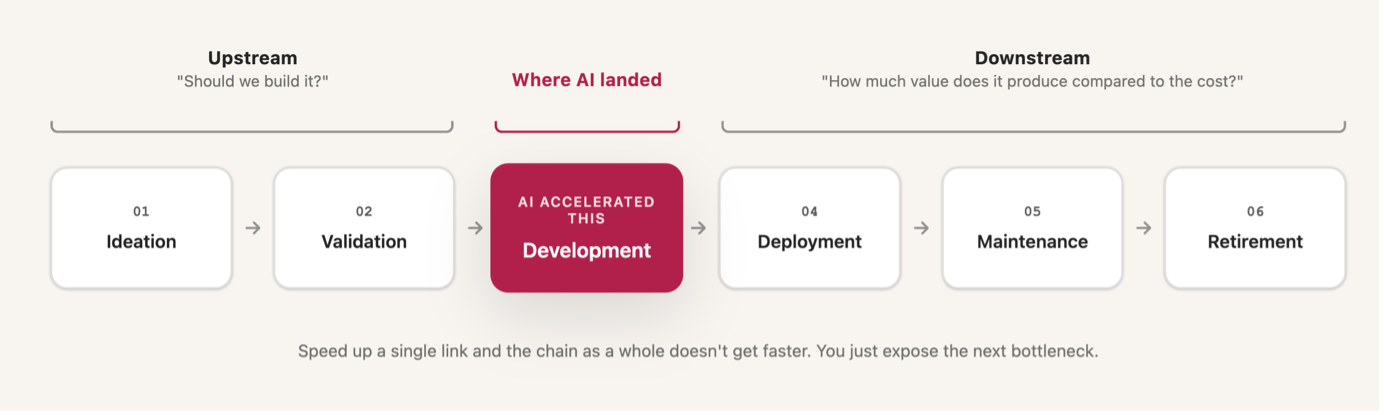
For most product teams, coding was never the only (or even the primary) bottleneck. Delivering a digital service is a chain of stages, from ideation through validation, development, deployment, maintenance, and retirement. Speed up a single link and the chain as a whole doesn't get faster; you just expose the next bottleneck.
Speed up the development link, and two bottlenecks surface on either side of it. The upstream one is knowing what to build, i.e., do you actually have validated concepts worth committing to? The downstream one is the cost to live with every feature you ship: the complexity and upkeep each one piles on for years.
The Waste Accelerator and theInnovation Bottleneck
Now picture a team that has sped up only the middle of that chain, the development link, and left the rest alone. They're building every feature anyone can think of. Minor changes take a thought; larger features ship in a sprint. A few months later, at the quarterly KPI review, nothing has improved. Worse, user satisfaction is down and the upkeep is costing more.
What has happened is what we call the waste accelerator. When building gets cheaper and faster, teams stop asking whether a thing is worth building at all. The easier it is to ship, the harder it is to pause and ask "should we?"
You can see it in the code itself. GitClear's analysis of hundreds of millions of changed lines found that AI-heavy development leaves more redundant code behind and cleans up less of it. That redundancy is added complexity, and complexity is the single biggest driver of long-term maintenance cost.
And maintenance is only part of the bill. Every feature you ship also pulls in QA cycles, security patching, documentation, and support training, costs nobody budgets when they decide to build it. They compound quietly, until most of the team's capacity goes to keeping old features alive and only a sliver is left for building new ones.
The cycle reinforces itself: faster to production means more surface area, which means more maintenance, which means less capacity for validated work, which means more pressure to ship without validating, which in turn means more surface area still. The question isn't whether AI can produce code faster. It's whether anything upstream ensures that faster software development creates value rather than obligation.
This is the upstream problem we call the innovation bottleneck. In the rush to accelerate development, the innovation phase gets left behind. Yet development runs on a feed of validated ideas, and without it, a fast team is an engine at full throttle with no steering wheel: burning fuel, making noise, going nowhere in particular.
AI could feed that steering wheel just as well the engine. It mostly doesn't, and the reason is organizational, not technical: coding had decades of tooling and a culture of automation, while figuring out what to build never did. So when AI speeds everything up, development surges ahead and discovery stays at its old pace, because the habits haven't moved yet.
That gap is new. For decades, "can we build it?" was the binding question, and slow building worked as a filter. You couldn't ship every idea, so ideas had to compete. It was frustrating, but it forced prioritization. AI weakened that constraint and, with it, quietly removed the filter. Now nothing stands between a half-formed idea in a meeting and a feature in production except someone's enthusiasm.
So the bottleneck moved. It didn't disappear but rather relocated, from "can we build it?" to "should we?" Most organizations have no infrastructure for answering that second question at speed. Their delivery side is mature (sprints, CI/CD, code review, retros) while their discovery side is still "someone had an idea." When building was slow, that imbalance was survivable. Now it's the bottleneck.
Point the Speed Upstream
The same AI speed that created the waste accelerator can help break the innovation bottleneck. If AI can stand up a working feature in days, it can stand up a rough experiment in hours. Something to explore an idea, test it, and learn whether it's worth pursuing. This, however, is too often left out because things can get scary.
When you’re creating wild ideas, testing and validating them, and filtering out the true gems, you will quickly find out that not all ideas work. But failure in innovation isn’t failing, it's the whole point. It’s the price you pay for good products.
Pay upstream, with a rough prototype and a week of user testing, and failure costs days while teaching you a lesson. Pay downstream, with a shipped feature nobody wanted, and failure costs months : a maintenance bill that runs for years, and the better feature you never built because that capacity was spent. AI can accelerate failure in either direction. The smart move is to make it happen early, where being wrong costs days instead of years.
Upstream, AI has plenty to chew on. It can surface patterns and opportunities from masses of raw signal: customer complaints, support tickets, usage data. It can spin one initial idea into multiple concept variations, giving you more material to validate, and it can also speed up the validation itself.
At strategic level AI can track competitors and sketch future scenarios. (Beware though, you have to work to stay relevant to your context and not end up repeating the same generic pointers your competitors are getting from AI too!)
The hardest part of the process might still be knowing what not to build. That’s why we recommend using a pre-defined framework to help with the decision-making. It's important that all decision-makers can stand behind it, so shape it to fit your own organization. A framework that considers upstream strategic fit and demand validation, as well as downstream lifecycle cost can look like this:
The Build/Kill Decision Framework
"We could build it" is not the same as "we should build it." Those are very different sentences. The following three gates make that distinction concrete. Every significant feature should clear them before development begins.
Gate 1: Demand Validation
- Who validated demand with actual users, not internal assumptions?
- How many validated concepts are competing for this same development slot?
- What would make us kill this, and who makes that call?
Rule of thumb: no development slot goes to a concept that hasn't been validated against real users first.
Gate 2: Lifecycle Cost
- What does it cost to maintain this for three years, not just to build it?
- Does this add complexity, or replace something that's already there?
- Who owns it after launch, including ongoing support, not just the deployment?
Rule of thumb: in a mature product, kill one old feature for every major new one you add.
Gate 3: Strategic Fit
- Does this serve the 18-month direction, or is it a detour?
- If a competitor shipped it tomorrow, would it actually matter?
- Does this reinforce what we're known for, or blur it?
Rule of thumb: if you can't tie it to the current strategic priority in one sentence, it waits.
Each gate is one more place to say no while saying no is still cheap.
So What
The teams that get real value from AI are the ones good at saying no. They have three things in place: a steady supply of validated ideas, an honest count of what each feature costs to keep alive, and the discipline to kill what isn't working before it hardens into something permanent. And they use AI to explore and validate ideas, not just to build them.
AI has made building faster, and the expensive mistake is no longer shipping too slowly. It's shipping the wrong thing, and paying for it forever.
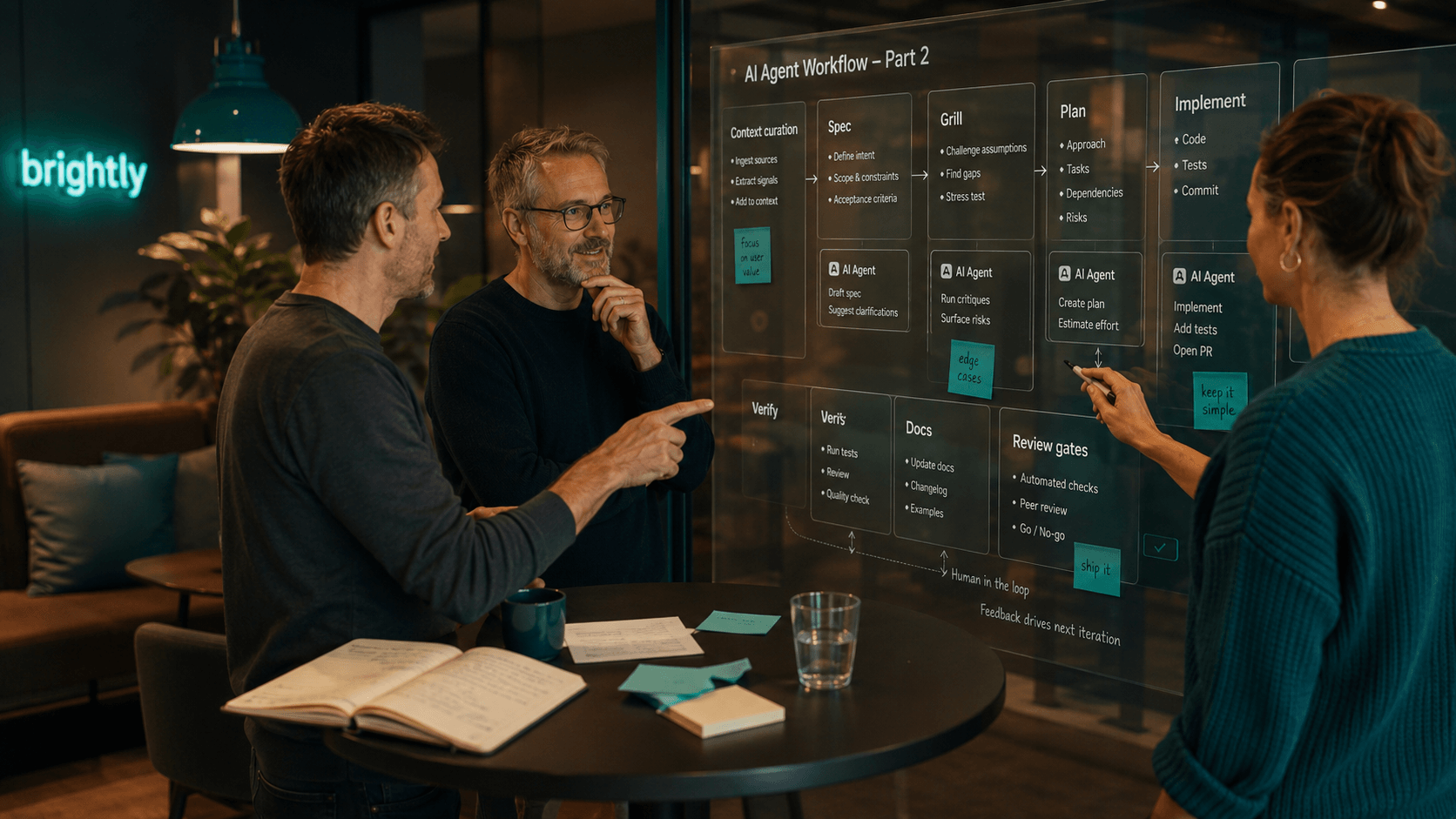
We practiced what we preach here. AI sat in on a spitballing session between Brightly's AI and Design leads and spiked a few outlines. We threw most away and built the survivor into this post. The thesis, and every line of the final draft, passed through human hands and eyes.



.png)